


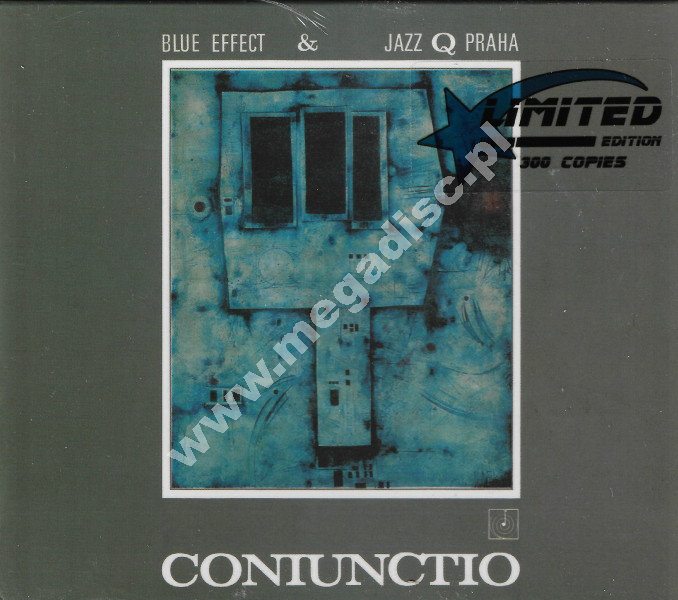
BLUE EFFECT & JAZZ Q PRAHA - Coniunctio - KRAY Edition
BLUE EFFECT (Modry Efekt)
Genre:
Medium: CDs
Recording date: 1970
Country: Czechoslovakia
Availability: in stock – dispatched within 1 day
Medium: CDs
Recording date: 1970
Country: Czechoslovakia
Availability: in stock – dispatched within 1 day
AVAILABLE
price: 80,00 PLN / 20,00 EUR
"Still in the line-up with the first vocalist, the musicians of The Blue Effect were increasingly orienting themselves towards jazz, because firstly the decision-making circles in Czechoslovakia looked favourably on the increasingly popular 'music of oppressed American minorities', and secondly instrumental pieces or abstract titles did not come into conflict with the omnipresent censorship.
In March 1970 the instrumental trio The Blue Effect in the line-up of Hladík, Kozel and Čech again entered the Prague recording studio of Supraphon in order to record, together with the free-jazz Prague band Jazz Q Praha (led at the time by wind virtuoso Jiří Stivín and keyboardist Martin Kratochvíl) during a one-day session something in the nature of a modern, jazz-rock equivalent of Ornette Coleman's classic album Free Jazz: A Collective Improvisation (Atlantic, 1961), on which (to put it briefly) two jazz quartets - including two rhythm sections - played their own thing, but... side by side. To readers who are fleeing in panic right now (or turning the page) I ask for patience, because the Czech 'super-session' turned out to be a very successful work, at times brilliant, though not free of cacophonous, hard-to-bear passages. The first side of the LP Coniunctio, released in 1970 by Supraphon but for members of the Czech Record Club, was filled by the nearly 20-minute Coniunctio I (In Memoriam Lubomír Pristof), composed by the two leaders of Jazz Q and performed by both bands. It is hard to describe this composition, because a great deal happened in it! After a cacophonous and theoretically hard-to-bear 30-second introduction, ensemble playing emerged from the chaos, decidedly progressive, though close to anarchy, with Radim Hladík playing a juicy, overdriven solo in the right channel, while on the left the Jazz Q musicians tried to 'throw him off balance', but at the same time, with piercing sounds from saxophone, organ and drums demolished by the drummer, played somewhat 'off to the side', added a peculiar colour to this music. It can't be denied that the best playing came in the 8th minute, when in both channels the guitarist reigned supreme with his twisted, progressive boogie. Then came a 6-minute passage devoid of rock elements, appropriated first by Stivín charmingly improvising on flute, whom the other three musicians then replaced, until in the 15th minute, after another stylistic turn, rock magic briefly returned, because both bands sounded together like a heavily twisted Jethro Tull... The last 3 minutes of the piece were devoted to a consistent calming of emotions... All in all it is a chunk of bold and loud playing that in 1970 certainly brought these musicians no shame! What a pity that in Poland nobody played like that (jazz-rock) at the time!
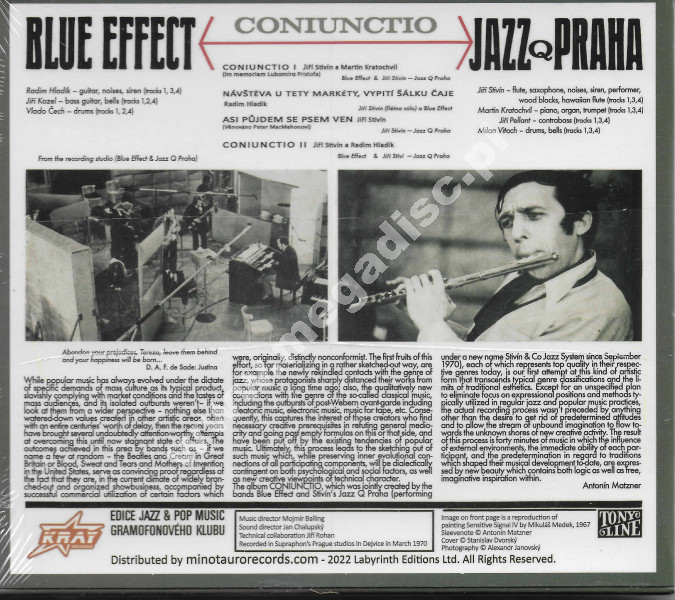
The second side was opened by the 6-minute piece Návštěva U Tety Markéty, Vypití Šálku Čaje (in the export version titled A Visit To Aunty Margaret For A Cup Of Tea) - a piece that I fell in love with nearly 30 years ago - almost ignoring the first part of the album! Dominated by the exceptionally rock-minded, but playing at a fairly medium tempo, Blue Effect, adorned with splendid, Jethro Tull-like flute parts from the leader of Jazz Q and at the same time brimming with tasty, feisty guitar solos, this piece sounded as good as (if not better than) the best progressive bands from the British Isles! Importantly, in this piece Hladík clearly showed in which direction he would head on the next, big record! By contrast, in the 7-minute and completely jazz Asi Půjdem Se Psem Ven (Perhaps We'll Probably Take The Dog Out) only Jazz Q Praha appeared - and in its free-jazz style tested the material endurance of saxophone, piano, double bass and drum kit. The whole was closed by the over 7-minute Coniunctio II, composed by Hladík and Stivín and performed by both bands - a number based on a slightly swaying, slow, rock rhythm, as if blues-progressive (halfway close to the free-jazz style), dominated by Hladík wailing on guitar, Kratochvíl playing psychedelically on organ and Stivín blowing mercilessly into the saxophone. In my view the LP Coniunctio is the last border point between full-of-passion, bold, early, pioneering jazz-rock and the place called Jazz, where it is cold, alien and which you want to leave as quickly as possible. Even 3-4 years later this kind of album, with the rock part played more conservatively, probably in the fusion style and given more modern production - would have been hard for me to listen to. As I already mentioned, made in a thin, easily worn-out sleeve (with two photos on the back), the album also came out in an export version with a navy blue Supraphon label on the vinyl - with a laminated, glossy and almost identical front, but with only one photo of both bands playing together in the studio on the back cover. Finally I will add that the record is considered a full-fledged discographic title of both bands, so it will also appear further on, as the debut of the group Jazz Q!" REVIEW BY JACEK LEŚNIEWSKI FROM A BOOK ON ROCK FROM THE FORMER EASTERN BLOC, BEGUN BUT ABANDONED AFTER HALF A YEAR (2021).
A limited edition, new, sealed.